Theory
The whole device is usually divided into three parts: Antenna, Receiver, Decoder. All the analogue processing happens within the receiver. It outputs what's called 'video', i.e. demodulated signal. This video is then fed to the decoder which looks for ADS-B frames (there are many other signals at 1090 MHz ) and feeds them to a PC.
So what's the problem with the existing popular designs?
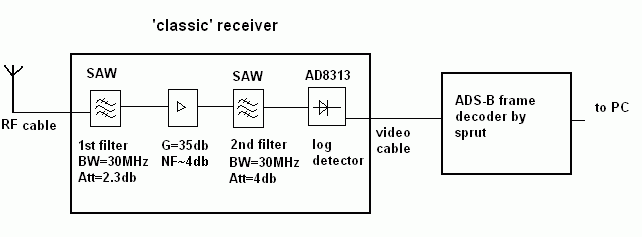
You have a signal from the antenna that is attenuated by a cable (usually 1db to 5db), then by the SAW filter (2.3db). This signal is then fed to a noisy (NF~4db) amplifier, followed by another SAW filter with a noise bandwidth (30MHz), far wider than the useful spectrum of the signal. It looks like a bad receiver, don't you think?
The spectrum of ADS-B signals is let's say about 10 or 20 MHz, but since we don't wanna make a radar or an MLAT receiver, we don't care about how good the leading edges are. We only care about the data that's inside. We only need about 3 MHz of bandwidth! (look at the spectrum of the ADS-B signal)
Here's my design:
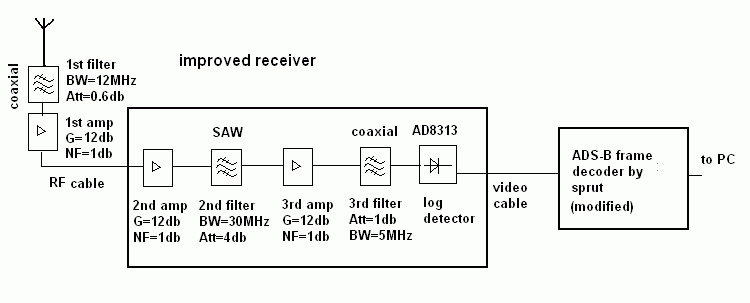


You see that the first RF filter has a smaller attenuation (0.6db), and it's closer to the first amplifier and to the antenna. Thus I reduce the attenuation of the filter and the cable. I use a low-noise (NF~1db) amplifier. Just by doing this, you can improve your receiver's sensitivity by at least 6db.
Furthermore, by reducing the noise bandwidth of the last filter to about 6Mhz (filter bandwidth is not always equal to noise bandwidth), I gain another 6db.
And there's one more trick: I do another filtering at video frequency just before the decoder. Wheter I gain something out of it, I can't say for sure, but the signals definitely look better after that (less spikes). Arguably, there may be 1db improvement there.
So I talk about 12 db improvement. Is this possible?
Practically, the improved receiver is 9 db more sensitive. This means increasing the free space range by a factor of 2.8!
BUT...we aren't in free space. If your radio visibility is limited to say 100NM, there will be no great improvement. The classic receiver, if well built, will work fine even beyond 100NM.
So why bother? If you have a good radio visibility, it's worth the effort. Furthermore, you can use a much smaller antenna, especially if you need a mobile design. A simple J-pole or even quarter-wavelength antenna will work just fine to 200NM.
Furthermore, by reducing the noise bandwidth of the last filter to about 6Mhz (filter bandwidth is not always equal to noise bandwidth), I gain another 6db.
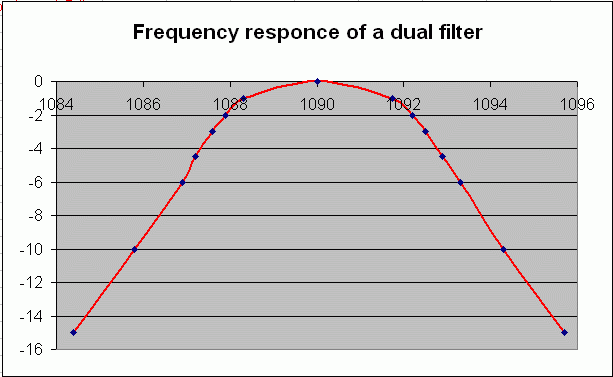
And there's one more trick: I do another filtering at video frequency just before the decoder. Wheter I gain something out of it, I can't say for sure, but the signals definitely look better after that (less spikes). Arguably, there may be 1db improvement there.
So I talk about 12 db improvement. Is this possible?
Practically, the improved receiver is 9 db more sensitive. This means increasing the free space range by a factor of 2.8!
BUT...we aren't in free space. If your radio visibility is limited to say 100NM, there will be no great improvement. The classic receiver, if well built, will work fine even beyond 100NM.
So why bother? If you have a good radio visibility, it's worth the effort. Furthermore, you can use a much smaller antenna, especially if you need a mobile design. A simple J-pole or even quarter-wavelength antenna will work just fine to 200NM.